
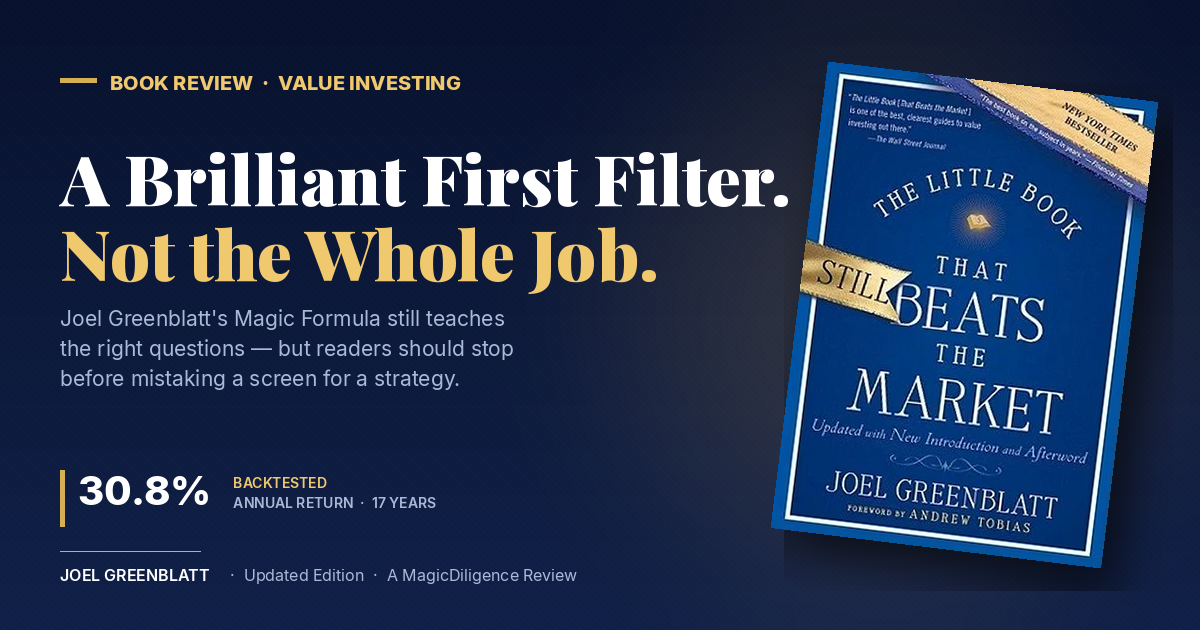
Joel Greenblatt's The Little Book That Still Beats the Market remains one of the clearest introductions to rational stock investing because it teaches readers to think about stocks as partial ownership in real businesses, not flashing ticker symbols. It is funny, fast, and unusually practical. But the same simplicity that makes the book powerful is also its main limitation: the Magic Formula is an excellent starting filter, not a complete modern investing process.
What the Book Is Really About
Many people remember the book as "the Magic Formula book," but Greenblatt's real achievement is earlier and more basic than the screen itself. He tries to rewire the reader's mental model. Instead of asking whether a stock is "going up," he asks what the underlying business earns, what capital it needs, and whether the market is offering that business at a bargain price.
That sounds obvious to experienced investors. It is not obvious to beginners. Most people encounter the market as noise: price charts, pundit takes, quarterly beats, panics, rallies. Greenblatt strips that away. His kid-friendly gum-shop examples and the old Benjamin Graham "Mr. Market" framing do what good investment writing should do: they make the right questions feel intuitive.
That is why the book still matters. Even if a reader never screens a single stock, the book teaches three habits that age well. First, compare any prospective investment against a plain alternative, like a safe bond yield. Second, treat volatility and value as different things. Third, demand a margin of safety between what a business is worth and what you pay.
What Greenblatt Gets Right
Greenblatt's biggest strength is that he makes disciplined value investing feel accessible without turning it into mysticism. He is trying to show ordinary investors that they do not need to out-chat Wall Street. They need a rational framework and the willingness to stick with it.
The core formula is also more thoughtful than its marketing nickname suggests. In the appendix, the book defines "cheap" as a high earnings yield, measured with EBIT relative to enterprise value, and "good" as a high return on capital, measured with EBIT relative to net working capital plus net fixed assets. That is more robust than a naive low-P/E screen. It tries to compare operating earnings across companies with different tax rates and leverage, and it tries to distinguish real business quality from accounting optics.
Greenblatt also deserves credit for not stopping at one flashy backtest. He shows the strategy across different size buckets, points out that the ranking works in order rather than only on a few lucky picks, and emphasizes diversification. That is important. He repeatedly says the formula should be used across roughly 20 to 30 stocks, not as a license to fall in love with one cheap name.
He is also more practical than many people remember. The step-by-step section tells readers to phase in five to seven names at a time, build toward a portfolio of 20 to 30 stocks, and keep going for at least three to five years regardless of short-term results. That advice matters. It makes clear that the Magic Formula is a portfolio discipline, not a stock-tip machine. Many books about systematic investing explain the signal but not the behavior required to harvest it. Greenblatt at least tries to close that gap.
Just as important, he is refreshingly honest about the behavioral problem. The most durable part of the book may be his argument for why the strategy can keep working even after it becomes public: most people will abandon it. In his test period, the formula lagged the market in many individual months, failed to beat it in roughly one out of four one-year periods, and sometimes trailed for multiple years in a row. That is not a footnote. It is the whole game. Greenblatt understands that an edge survives when it is psychologically difficult to hold.
Where the Book Comes Up Short
The problem is that the same simplicity that makes the book readable also makes it easy to over-trust.
Calling it a "magic formula" is clever salesmanship, but it inevitably suggests more precision than real investing allows. The screen uses hard numbers, yet the world that produces those numbers is messy. Last year's EBIT may be inflated by peak-cycle demand, temporary spreads, one-off contracts, or acquisitive accounting. A company can look cheap because earnings are about to fall, because debt is becoming dangerous, or because the market has noticed a risk the formula cannot see.
Greenblatt knows some of this and says the formula works "on average." But many readers will still come away feeling that the mechanics are doing more of the work than they really are. In practice, the formula is blind to several things that matter a lot: fraud risk, balance sheet stress, customer concentration, cyclical peaks, regulatory pressure, and the difference between reported profitability and durable profitability. Those gaps do not invalidate the approach. They simply mean the approach is incomplete.
There is also a more technical simplification hiding underneath the book's breezy tone. The actual study excludes financials and utilities, relies on recent reported statements, and uses specific proxies for business quality and cheapness rather than timeless laws of nature. Those choices are reasonable for a broad quantitative screen. But they are still modeling choices. Readers who do not notice that distinction can start treating the formula as if it were discovering objective truth, when really it is using one disciplined but imperfect lens on value.
That is especially true now. Modern markets are faster, data is more accessible, and obvious factor screens are more crowded than they were when the book was first published. The edge may still exist, but readers should be more humble about where it comes from. The book's backtested 30.8% annual return over 17 years is striking, but it is still a historical study shown in a persuasive narrative. It should inspire investigation, not replace it.
The implementation advice also feels dated in places. The tax discussion reflects an earlier regime. Some of the screening references belong to another internet era. Even the idea that a free public website can faithfully replicate the study should be treated cautiously. None of that damages the philosophy, but it does remind you that this is not a modern operating manual. It is a conceptual guide.
The Right Way to Read It Today
The best way to read Greenblatt now is not as a promise but as a filter.
Read it first as a book about how to think. Stocks are businesses. Price and value are not the same. Good businesses become great investments only when the price is right. Bad stretches are not proof that a sound process is broken.
Then read it as a screening framework. High earnings yield and high return on capital are still useful clues. They are a smart way to cut a huge market down to a manageable watchlist.
But stop there. After the screen, real work begins. That is exactly why the Magic Formula needs one more step. You still need to ask whether the earnings are normal, whether the balance sheet can survive stress, whether management is credible, whether the business is cyclical, and whether the apparent quality is durable or just statistical. That is the part the book cannot automate. It is also the part that separates a good idea from a good portfolio.
That, in a sense, is the fairest criticism of the book. Greenblatt is so good at simplifying the front half of the process that some readers may miss how much judgment the back half still requires. The Magic Formula can rank opportunities. It cannot fully understand them.
Final Verdict
This is still one of the best short books an investor can read early in their journey. It is engaging, memorable, and intellectually clean. Greenblatt does an excellent job teaching the logic behind buying good businesses at bargain prices, and he does not hide the uncomfortable fact that a sound strategy can look foolish for long stretches.
At the same time, the book is best treated as a foundation, not a finished system. If you follow it literally and mechanically, you will eventually own some businesses you would never have touched after even modest due diligence. If you use it as intended but then add skepticism, normalization work, and risk checks, it becomes much more valuable.
So the verdict is simple: read it, learn from it, and keep it on your shelf. Just do not confuse a strong first filter with the whole job. Greenblatt gives you the logic. The investor still has to supply the judgment.
If you want to see what that next layer of judgment looks like in practice, click back to the current MagicDiligence screen results.