
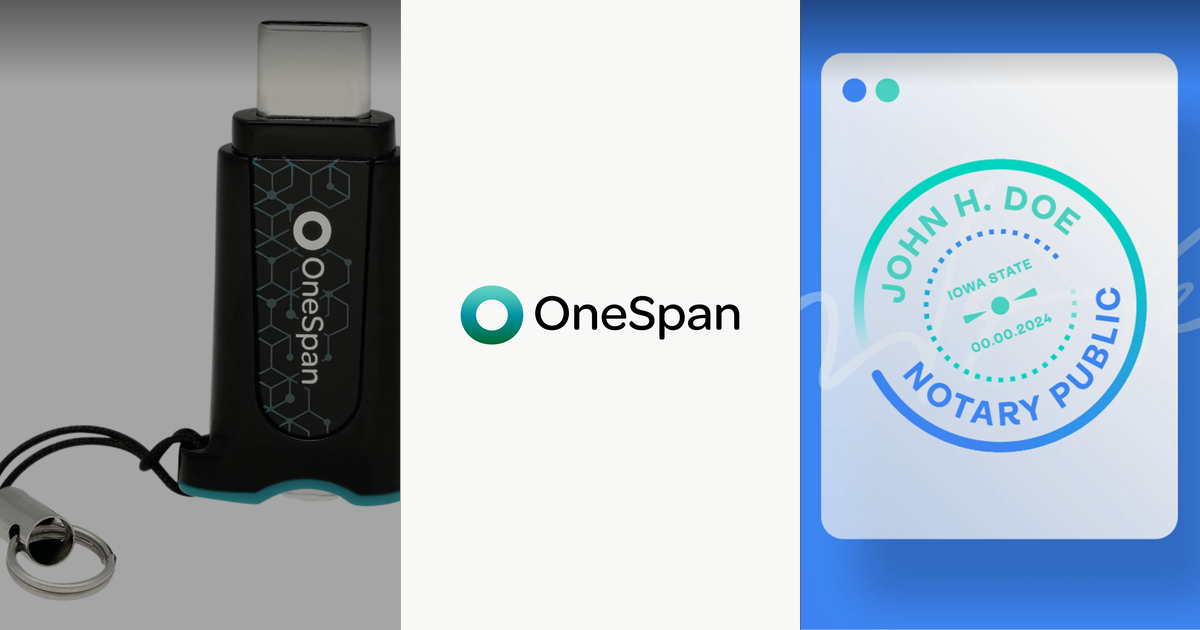
OneSpan Inc. (OSPN) screens on the Magic Formula, holds a MagicDiligence Pass rating, and has posted positive relative strength against the market over the past six months — yet the stock trades at roughly 8x trailing earnings while the S&P 500 sits near 40x. The skepticism is not without logic on the surface: OneSpan has been associated for most of its history with the Digipass authenticator token, a physical hardware device that banks issue for multi-factor authentication and that is being steadily displaced by mobile software. But the hardware narrative is badly out of date. As of 2025, Digipass devices represented just 20% of total revenue, down from 78% a decade ago, and the subscription software business is running at a $192 million annual recurring revenue run rate, up 14% year-over-year in the most recent quarter. The stock is priced for a dying hardware vendor. The business, increasingly, is a sticky subscription software company securing digital banking for most of the world's largest financial institutions.
From Physical Tokens to Digital Banking Infrastructure
OneSpan has roots going back to 1991, when it was incorporated as VASCO Corp. and built its early identity around Digipass tokens — the pocket-sized devices that banks distributed to customers to generate one-time passwords for online transaction authentication. For more than two decades, that hardware product defined the company's revenue, its customers, and its stock multiple. VASCO went public in 1998 and changed its name to OneSpan in May 2018. Following a painful period of over-investment and operating losses that produced a $29.8 million net loss in 2023, the company executed a restructuring that eliminated roughly 345 positions, cut operating expenses sharply, and pivoted the go-to-market strategy toward software subscriptions and cloud delivery.
Today, OneSpan operates through two segments. Cybersecurity — the larger segment at $177.7 million in 2025 revenue — covers authentication software, mobile application security and shielding, fraud prevention, and the declining Digipass hardware line. Digital Agreements, at $65.5 million in 2025 revenue, delivers e-signature (OneSpan Sign), online notarization (OneSpan Notary), and identity verification services in the same space as DocuSign and Adobe Acrobat Sign. The installed customer base is global and entrenched: more than 60% of the world's 100 largest banks rely on OneSpan products, and the company processes over 100 million digital agreements and billions of secure authentication transactions across more than 120 countries each year.
The Subscription Transition, in Numbers
The most important story in OneSpan's financials is invisible at the total revenue line. Revenue was $243.2 million in both 2024 and 2025 — essentially flat. What changed dramatically below the surface was the mix. Subscription revenue grew from $106.4 million in 2023 to $139.4 million in 2024 to $156.1 million in 2025, a 47% increase in two years. Hardware revenue fell from $76.0 million in 2023 to $58.9 million in 2024 to $49.1 million in 2025, a 35% decline over the same period. The hardware contraction consumed nearly all of the software growth at the aggregate level — but that dynamic is self-correcting as hardware shrinks toward a smaller and smaller base.
Annual Recurring Revenue, the company's forward measure of its subscription business, stood at $186.9 million at December 31, 2025, up 11% year-over-year. In Q1 2026 it rose to $192.1 million, an acceleration to 14% year-over-year growth. Net Retention Rate — which measures year-over-year ARR growth within the prior year's existing customer cohort — was 105% in Q1 2026, meaning current customers are, on net, buying more than they were a year ago. The company also formally exited its multi-year restructuring plan at December 31, 2025, having completed all planned headcount reductions and vendor rationalizations.
Gross margins followed the mix shift upward: 67% in 2023, 72% in 2024, 74% in 2025 and again in Q1 2026. As the high-margin software subscription base grows and low-margin hardware shrinks, the structural direction of margins is clear.
A Deceptively Cheap Valuation
At roughly $14.44 per share, OneSpan's market capitalization is approximately $535 million. With $49.8 million in cash and zero drawn on its $100 million MUFG revolving credit facility as of March 31, 2026, enterprise value is roughly $485 million.
Against the full-year 2026 Adjusted EBITDA guidance midpoint of $66 million, that is a forward EV/EBITDA multiple of approximately 7.3x. Software companies with OneSpan's gross margin profile (74%) and ARR growth rate (14%) typically trade at 12 to 20x EV/EBITDA. The S&P 500 as a whole, by comparison, trades at roughly 40x trailing earnings and 25x forward earnings according to current consensus estimates.
The trailing GAAP P/E of about 8x against 2025 net income of $72.9 million requires a footnote: that figure includes a $23.5 million non-recurring income tax benefit from the release of valuation allowances on Canadian deferred tax assets. Without that one-time tailwind, pre-tax operating income was $49.4 million, and at a normalized 20% tax rate the underlying earnings power is roughly $39.5 million, or about $1.02 per diluted share. Even on that more conservative basis the stock is trading at approximately 14x — still a substantial discount to the broader market and an extreme discount to software peers. Forward consensus EPS of $1.22 per share (per Seeking Alpha) implies an 11.8x forward GAAP multiple.
Cash generation is real and recurring. Operating cash flow was $59.5 million in 2025, and after $9.0 million in capital expenditures, free cash flow was approximately $50.5 million. That equals a free cash flow yield of roughly 9.4% on the current market capitalization — the kind of number that has historically attracted value-focused buyers.
OneSpan returned $31.6 million to shareholders in 2025 through dividends and share repurchases. The board raised the quarterly dividend 8.3% to $0.13 per share in February 2026, putting the annualized rate at $0.52 and the current yield at 3.6%. The payout ratio against even the normalized earnings figure is approximately 50%, leaving room to sustain and continue growing the payment. The company repurchased roughly 1.5 million shares over the twelve months ended March 31, 2026.
Where the Bear Case Has Merit
None of the above resolves the legitimate concerns about OneSpan's near-term trajectory. Analysts at Seeking Alpha framed the issue accurately after the Q1 2026 earnings release: growth potential "remains clouded as the legacy business drags." Total revenue is essentially flat, and it will remain roughly flat through at least 2026 while subscription gains work through the system. More importantly, the 2026 Adjusted EBITDA guidance of $64 to $68 million is lower than the $77.6 million reported in 2025, because the company is reinvesting the prior-year savings into sales and marketing and research and development to support three acquisitions completed since June 2025 — Nok Nok Labs (FIDO passwordless authentication, $14.7 million), a 15% stake in ThreatFabric (mobile threat intelligence, $11.7 million), and Build38 (mobile application protection, $34.6 million in cash at close).
Q1 2026 operating income fell 14% year-over-year to $14.8 million as S&M and R&D spending ramped. That is not a structural deterioration, but it is a sign that the company is voluntarily absorbing near-term earnings pressure to build out its product surface area. Whether the Nok Nok and Build38 integrations deliver commercial traction is unproven.
Competition is also genuine. DocuSign and Adobe have vastly greater brand recognition and sales infrastructure in e-signatures. In authentication hardware, Thales (Gemalto), Yubico, and RSA Security are credible competitors. OneSpan's relative lack of brand awareness, acknowledged explicitly in its 10-K, has made new customer acquisition harder and slower than retention and expansion.
Multiple executives also sold shares during early 2026 when the stock was trading in the $10-11 range. Most were routine vesting-related transactions, but they are a factual data point.
What the Case Rests On
OneSpan does not need to be re-rated as a premium cybersecurity software platform to deliver acceptable returns from the current price. It needs the subscription business to maintain 10-15% ARR growth, the Digital Agreements segment to continue gaining gross margin, and the M&A portfolio to expand into the authentication market's fastest-growing dimensions. In June 2026, OneSpan launched an early-access digital credentials program at the Identiverse conference — a signal that it is positioning for the emerging market in digital wallets and verifiable credentials. Separately, KuppingerCole named OneSpan an Overall Leader in the 2026 Leadership Compass for Passwordless Authentication for Enterprises, a designation that carries weight with the compliance-conscious bank technology buyers who make up the company's core customer base.
At 7-8x forward EBITDA, a 3.6% dividend yield, no debt, and ARR growing 14% year-over-year, the stock is priced for stagnation that is not supported by the underlying operating metrics. The market has spent the past several years discounting OneSpan for the hardware it is losing rather than the subscription software it is gaining. At some point that math stops working.
| Current OSPN read | Value |
|---|---|
| MagicDiligence verdict | Pass |
| Momentum read | Positive 6M vs SPY (+35% vs +14%) |
| Why it screens | High free cash flow yield, clean balance sheet, ARR growing 14% |
| Main bull point | $192M ARR at 14% growth, 74% gross margins, 7-8x EV/EBITDA, 3.6% dividend, zero debt |
| Main risk | Legacy hardware declining; 2026 EBITDA guided below 2025; DocuSign/Adobe competition; M&A integration execution |
If you want to compare OneSpan with the rest of the current shortlist, go back to the current MagicDiligence screen results.
References
- MagicDiligence report on OneSpan Inc.
- OneSpan Inc. Annual Report on Form 10-K for the fiscal year ended December 31, 2025
- OneSpan reports first quarter 2026 financial results — earnings press release
- OneSpan Quarterly Report on Form 10-Q for the period ended March 31, 2026
- MarketBeat: OneSpan (OSPN) stock analysis, analyst ratings, and price target
- Seeking Alpha: OneSpan's Growth Potential Remains Clouded As Legacy Business Drags (Downgrade)
- BusinessWire: The Shift to Digital Credentials Accelerates — OneSpan Launches Early Access at Identiverse (June 2026)
- Yahoo Finance UK: OneSpan Inc. (NASDAQ:OSPN) Looks Interesting, And It's About To Pay A Dividend