
HP Inc. (HPQ) screens on the Magic Formula, holds a MagicDiligence Pass rating, and has posted positive relative strength against the market over the past six months — yet Wall Street's consensus is "Reduce," and the stock trades at roughly 9× trailing earnings while the S&P 500 sits near 40× and the broader Computer and Technology sector trades at an extraordinary 79×. The market has spent years treating HP as a melting ice cube: a legacy PC and printer company being slowly disintermediated by mobile devices, cloud document workflows, and Lenovo's relentless price competition. The trouble with the thesis is that the ice cube keeps printing cash. Over the past twelve months HP generated approximately $3.7 billion in free cash flow — a 13% FCF yield on the current market capitalization — while compounding its quarterly dividend for 15 consecutive years and returning nearly $2 billion to shareholders through buybacks and dividends in fiscal 2026 alone. At this price, HP does not need to become a growth company to be interesting. It needs to hold the line on what it already has.
From a Palo Alto Garage to a $22 Billion Cash Engine
HP Inc. traces its roots to 1939, when Bill Hewlett and Dave Packard started the company in a rented Palo Alto garage with $538 and a used drill press. What followed was one of the great technology enterprise stories of the 20th century. The modern HP Inc. was created in November 2015 when the original Hewlett-Packard Company separated into two independent public companies: HP Inc., which retained the personal computers, printers, and the iconic HP brand and NYSE ticker HPQ; and Hewlett Packard Enterprise, which took the servers, storage, and enterprise IT services portfolio.
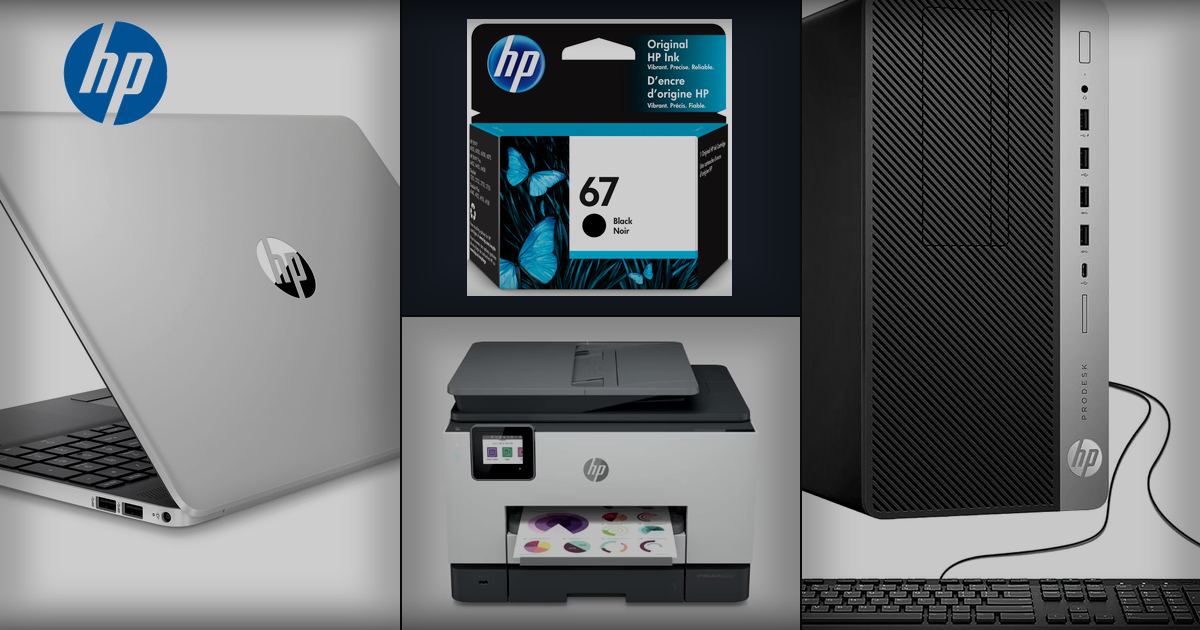
Today HP operates through two reporting segments. Personal Systems — roughly 71% of revenue — sells commercial and consumer laptops, desktops, workstations, displays, and accessories. Printing — the remaining 29% — sells inkjet and laser hardware, ink and toner supplies, managed print services, and a growing portfolio of device subscription contracts. The two segments look similar at the revenue line but operate differently beneath it.
Personal Systems is experiencing a genuine AI-driven commercial refresh. Commercial PS revenue grew 14% year-over-year in HP's fiscal second quarter ended April 30, 2026, reaching $7.7 billion. Enterprises are replacing aging device fleets with AI PC hardware capable of running local large language model workloads — a requirement that demands meaningfully more memory and processing power than prior-generation devices. HP has positioned itself squarely in that transition: its HP IQ platform embeds AI assistance directly into device management and productivity workflows, and in July 2026 HP announced an OpenAI Frontier partnership to co-develop AI-powered applications across its device and services portfolio. HP Wolf Security, which builds endpoint protection into commercial device hardware and firmware rather than as a software add-on, is a meaningful differentiator in government and regulated-industry accounts where BIOS-level security controls matter.
Printing is a different story. Consumer printing is under genuine secular pressure — consumer hardware units fell 8% year-over-year in Q2 FY2026, and consumer printing revenue declined 10%. But this is also the most commonly cited reason to avoid the stock, and it is the smaller piece of a more complicated business. Commercial printing was flat year-over-year. More importantly, the Supplies line — the ink and toner cartridges that are HP's version of the razor blade — generated $2.75 billion in Q2 FY2026, essentially unchanged from a year earlier. The HP+ platform converts hardware sales into ongoing supply relationships by tying customers who activate HP's extended services and Instant Ink subscription to genuine HP cartridges for the printer's lifetime. Print-as-a-Service adds managed print contracts on top. The result: the Printing segment generated an 18.3% operating margin in Q2 FY2026, making it one of the most profitable businesses in the computer hardware sector despite the secular narrative surrounding it.
The Numbers
HP's fiscal Q2 2026 results, reported May 27, materially beat expectations. Revenue was $14.4 billion, up 9.0% year-over-year. Non-GAAP diluted EPS was $0.86, beating consensus of $0.72 by $0.14 and up 21% from the prior-year period. HP raised its full-year non-GAAP EPS guidance to $2.90–$3.10 and reaffirmed free cash flow guidance of $2.8–$3.0 billion.
| Metric | Figure |
|---|---|
| H1 FY2026 revenue | $28.8B (+8% YoY) |
| H1 FY2026 non-GAAP EPS | $1.66 (+14% YoY) |
| FY2026 non-GAAP EPS guidance (midpoint) | $3.00 |
| FY2026 free cash flow guidance (midpoint) | $2.9B |
| Q2 Commercial PS revenue | $7.7B (+14% YoY) |
| Q2 Printing operating margin | 18.3% |
| Q2 Supplies revenue | $2.75B (+1% YoY) |
A note on GAAP versus non-GAAP: HP's reported GAAP EPS for H1 FY2026 was $1.07 per share against a non-GAAP figure of $1.66. The gap is almost entirely restructuring charges — $491 million in H1 FY2026 versus $192 million in the prior-year period, as HP simultaneously cuts legacy costs and invests in AI-enabling infrastructure while managing a CEO transition. These are real cash outlays in the near term. The key question for investors is whether they reflect one-time repositioning costs or a permanent drag. On current evidence, the FCF line — which is after capex and lease investments — is closer to the true earnings power than GAAP net income.
A Valuation That Requires Attention
At $24.22 per share, HP's market capitalization is approximately $22.2 billion. With $3.7 billion in cash and $9.7 billion in total debt on the April 30, 2026 balance sheet, enterprise value is roughly $28.2 billion.
At the FY2026 non-GAAP EPS guidance midpoint of $3.00, HP trades at 8.1× forward non-GAAP earnings — against the S&P 500's approximately 25× forward P/E and the Computer and Technology sector's 79× forward P/E. On trailing GAAP EPS of $2.71, the trailing P/E is 8.9× versus the S&P 500's ~40×.
Free cash flow is the most striking figure. The trailing twelve-month FCF is approximately $3.7 billion; at the FY2026 guidance midpoint of $2.9 billion (full-year FCF is typically much stronger in Q3 and Q4 than in the first half), FCF yield is roughly 13% on the current market capitalization. On a rough EV/EBITDA basis, using non-GAAP operating income of approximately $2.1 billion for H1 plus annualized D&A of ~$1.0 billion, trailing EBITDA approaches $6 billion and the EV/EBITDA multiple is approximately 4.7× — a figure that would be extraordinary for almost any technology-adjacent business.
Capital return is concrete and sustained. Over H1 FY2026, HP paid $551 million in dividends and repurchased $425 million in stock — $976 million returned in six months, or roughly $2 billion annualized on a $22 billion market cap. The board's $10 billion repurchase authorization, approved in August 2024, represents approximately 29% of shares outstanding; management has been deploying it methodically while maintaining the balance sheet. The dividend — $1.20 per share annualized — yields 4.96% with a payout ratio of approximately 35% against non-GAAP earnings and 3.4× FCF coverage. HP has grown its dividend for 15 consecutive years; nothing in the current capital structure threatens that streak.
Where the Bear Case Has Real Weight
The analyst consensus of "Reduce" (2 strong buy, 0 buy, 8 hold, 5 sell across 15 analysts) deserves to be taken seriously rather than dismissed.
Consumer printing is a structural decline story with no near-term catalyst for reversal. Consumer hardware unit volumes are contracting, and while HP+ supply subscriptions provide some offset through attach rates, the installed base is shrinking and the consumer Supplies line will eventually follow.
HP's projected earnings growth is essentially flat to slightly negative — MarketBeat shows analysts projecting EPS declining approximately 1.7% in the current fiscal year. That is not what a 13% FCF yield typically buys. If commodity input costs from PC memory and components rise further on tariff pressure (an explicit management risk factor), margins could compress meaningfully in Personal Systems, which runs at only 5.2% operating margin and has thin cushion.
The CEO transition is an unresolved overhang. Enrique Lores, who led HP's "Future Ready" transformation and the shift toward AI devices and services from 2019 onward, has departed. Interim CEO Bruce Broussard is a respected executive but his appointment adds uncertainty around the pace and direction of the AI PC and services investment program.
Finally, insider selling has been notable, and short interest at 9.63% of the float — recently increasing by 4% — indicates the skeptic community is not backing down at these levels. The stock has had two severe drawdowns in the past eighteen months (from $36 to $18 between late 2024 and February 2026, and an earlier decline before that), and technical traders who follow the 30-week moving average have been burned twice by early entries.
What the Thesis Rests On
HP does not need growth to deliver acceptable returns from the current price. It needs Commercial PS to sustain its AI PC-driven refresh momentum through fiscal 2027, Supplies to hold near current levels as HP+ attach rates offset the consumer installed-base contraction, and management to continue the disciplined capital return program while the permanent CEO search concludes. The OpenAI Frontier partnership, announced this week, will not in itself change the financial profile — but it confirms that HP has meaningful access to the AI application ecosystem rather than being a passive hardware supplier watching the value chain move around it.
At 8× forward non-GAAP earnings, a 5% dividend covered 3.4× by free cash flow, and approximately $2 billion in annual capital return on a $22 billion market cap, the stock prices in deterioration that the current operating data does not yet show. If the melting continues, the math eventually catches up. If the AI PC cycle and the resilience of the Supplies razor-blade keep the business roughly where it is, the gap between price and value closes on its own.
| Current HPQ read | Value |
|---|---|
| MagicDiligence verdict | Pass |
| Momentum read | Positive 6M vs. market (+32% in past 90 days from February lows) |
| Why it screens | High FCF yield, deeply discounted vs. market and sector P/E, sustained dividend grower |
| Main bull point | 13% FCF yield; 5% dividend covered 3.4×; Commercial PS +14% YoY on AI PC cycle; OpenAI partnership; $2B annualized capital return |
| Main risk | Consumer printing secular decline; CEO transition uncertainty; flat-to-negative earnings growth; commodity/tariff cost pressure; consensus "Reduce" |
If you want to compare HP Inc. with the rest of the current shortlist, go back to the current MagicDiligence screen results.
References
- MagicDiligence report on HP Inc.
- HP Inc. Annual Report on Form 10-K for the fiscal year ended October 31, 2025
- HP Inc. Quarterly Report on Form 10-Q for the period ended April 30, 2026
- HP Inc. fiscal 2026 second quarter results earnings press release
- MarketBeat: HP Inc. (HPQ) stock analysis, analyst ratings, dividend data, and price target
- Seeking Alpha: HP Is A High Yielding Undervalued Tech Stock (July 11, 2026)
- Yahoo Finance / Simply Wall St: HP (HPQ) Looks Fully Valued On OpenAI Deal And Earnings Beat (July 11, 2026)