
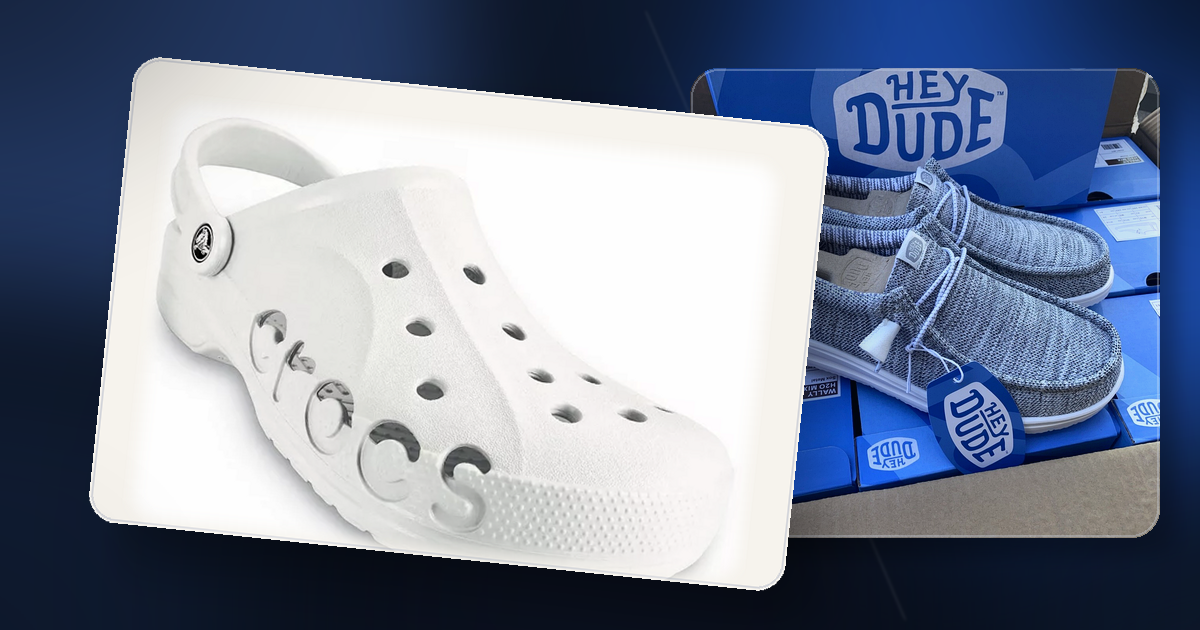
Crocs (CROX) still looks attractive for Magic Formula investors because the market is treating it more like a fad brand with HEYDUDE baggage than a durable global footwear franchise, even as the company continues to generate strong core profits, still passes the MagicDiligence checks despite active shareholder litigation, and shows strong relative momentum.
Few consumer brands look less serious at first glance than Crocs. The company built its name on foam clogs that were easy to mock, then turned that same polarizing product into one of the most recognizable casual footwear franchises in the world. Today Crocs sells footwear and accessories in more than 85 countries through wholesale and direct-to-consumer channels under both the Crocs and HEYDUDE brands.
That distinction is important because Magic Formula investors are not paid for buying boring businesses. They are paid for buying good businesses when the market is still framing them the wrong way. CROX looks like that kind of setup.
What Crocs Actually Owns
The simple version is that Crocs sells comfort footwear. The better version is that it owns an unusually durable product system.
The Classic Clog is the center of the story, but the business is bigger than one shoe. The company has built a brand around comfort, color, personalization, and collaborations, with Jibbitz charms, sandals, and adjacent silhouettes all widening the franchise. That has helped Crocs move from novelty item to repeat-purchase brand.
The company also benefits from an asset-light model. It designs, markets, and distributes the product, while relying on third-party manufacturers for most production. That is one reason the economics can stay strong when demand is healthy. In 2025, the Crocs Brand alone produced $3.33 billion of revenue and $1.11 billion of operating income.
HEYDUDE is the complication. Crocs bought the brand to expand into a broader casual footwear category, and the integration has been much messier than the market hoped. That is the main reason the stock still looks cheap enough to be interesting.
Why CROX Is On The Magic Formula Screen
Magic Formula is looking for two things: cheap earnings and strong returns on capital.
Crocs still makes sense on both.
The core Crocs Brand remains highly profitable. In the first quarter of 2026, Crocs Brand revenue rose 0.8% to $767 million, while segment operating income was still a very strong $253 million. Direct-to-consumer revenue for the brand grew 12.9%, and international revenue grew 7.2%. Those are not the numbers of a business that is losing relevance.
The returns-on-capital case is also easier to understand than many investors assume. Crocs does not need to own heavy manufacturing infrastructure to produce its footwear. It is largely monetizing brand equity, product design, distribution, and direct consumer demand. That is exactly the kind of model that can look exceptional on capital-efficiency metrics.
The value side comes from skepticism. Investors are still focused on tariffs, cautious consumer spending, and the drag from HEYDUDE. They are also staring at ugly 2025 GAAP results that included a $430 million HEYDUDE trademark impairment and a $307 million HEYDUDE goodwill impairment. Those charges were real, but they were also non-cash. They made the headline numbers look worse than the underlying earnings power of the business.
That is often where Magic Formula opportunities come from: not from perfect stories, but from businesses whose economic reality is better than the surface-level narrative.
Why CROX Passes MagicDiligence
The pass case is not that Crocs is flawless. It is that the problems look understandable and financeable rather than fatal.
Start with earnings quality. There is no sign here that revenue has been inflated by some one-time windfall or accounting gimmick. If anything, the distortion has run in the other direction. The big 2025 impairment charges made reported earnings look weaker than the operating business actually was.
Next is fraud and battleground risk. Crocs is dealing with securities and derivative litigation tied to prior wholesale inventory disclosures, so this is not a zero-risk story. But it still does not look like a classic blow-up setup built on collapsing liquidity, a short-seller campaign, or evidence that the business model itself is fabricated.
The balance sheet also looks manageable, even if it is not pristine. At March 31, 2026, Crocs had roughly $131 million of cash and $1.34 billion of total borrowings. That leverage is real. But so is the cash generation. The company produced $710 million of operating cash flow in 2025, had nearly $850 million of available borrowing capacity at the end of the first quarter, and has continued to reduce debt since the HEYDUDE acquisition.
Finally, this does not look like a classic peak-cycle mirage. Casual footwear is consumer discretionary, so it is not recession-proof, but it is also not a commodity or capital-goods business at the top of a boom. The stronger part of the company, the Crocs Brand, is still holding margins, growing internationally, and expanding its direct relationship with customers.
That is enough for a qualified pass, even if it is no longer a clean-sheet story.
What The Market May Still Be Missing
The easiest way to misunderstand Crocs is to think the company is selling one ugly shoe to one easily bored consumer.
The filings tell a different story. Crocs Brand international revenue was 48.6% of brand sales in 2025, up from 44.1% the year before. The business is also increasingly supported by direct channels, where the company controls pricing, merchandising, and brand presentation more tightly. In the first quarter of 2026, consolidated direct-to-consumer revenue grew 12.1% even as wholesale revenue fell.
That mix is important. A business that can keep growing direct sales while expanding internationally is not just harvesting an old fad. It is deepening the brand.
Management's latest guidance supports that view. After first-quarter results, Crocs raised its full-year 2026 outlook and now expects revenue to be down roughly 1% to up 1%, with adjusted diluted EPS of $13.20 to $13.75. That is not explosive growth, but it is more than enough if the market is still pricing the company as if the better years are behind it.
The buyback adds another layer. Crocs repurchased 6.5 million shares in 2025 for $577 million, and resumed repurchases in April 2026. When a company with meaningful free cash generation keeps reducing share count while sentiment is still mixed, per-share value can compound faster than investors expect.
Why The Momentum Reading Helps
MagicDiligence now tracks 6M vs SPY because value works better when the market is at least starting to agree with the thesis.
CROX has that extra support right now. The stock's strong relative momentum versus SPY suggests investors are beginning to separate the resilient Crocs Brand from the noisier HEYDUDE overhang. That does not prove the thesis, but it does make the cheapness more interesting.
A stock that looks optically cheap and has weak relative momentum can stay stuck for a long time. A stock that looks cheap, passes the qualitative checks, and is also showing relative strength is usually worth taking more seriously.
That is the setup here.
Why It Still Looks Buyable
To like CROX, you do not need to believe everything will go right. You only need to believe the core Crocs franchise will stay strong, HEYDUDE will stop being a major drag, and the market is being too pessimistic about the durability of the business.
That still looks reasonable.
The risks are real. Tariffs could pressure margins. Consumer softness could hit discretionary demand. HEYDUDE could take longer to stabilize than management expects. The litigation overhang may also keep some investors cautious.
But those are normal reasons for a stock to be mispriced. They are not the same as evidence that the business is broken.
For Magic Formula investors, that distinction is everything. You want a company with real earnings power, acceptable balance-sheet risk, and a stock price that still reflects doubt. Crocs fits that description better than many investors probably realize.
| Current CROX read | Value |
|---|---|
| MagicDiligence verdict | ✅ Pass, with caveats |
| Momentum read | Strong positive 6M vs SPY |
| Why it screens | Strong core EBIT, high capital efficiency, valuation still reflects skepticism |
| Main bull point | Durable Crocs Brand plus buybacks and international growth |
| Main risk | HEYDUDE stabilization, tariff pressure, and litigation overhang |
Crocs looks cheap because the market is still arguing with the story.
That is exactly when Magic Formula names get interesting.
If you want to compare CROX with the rest of the current shortlist, go back to the current MagicDiligence screen results.