
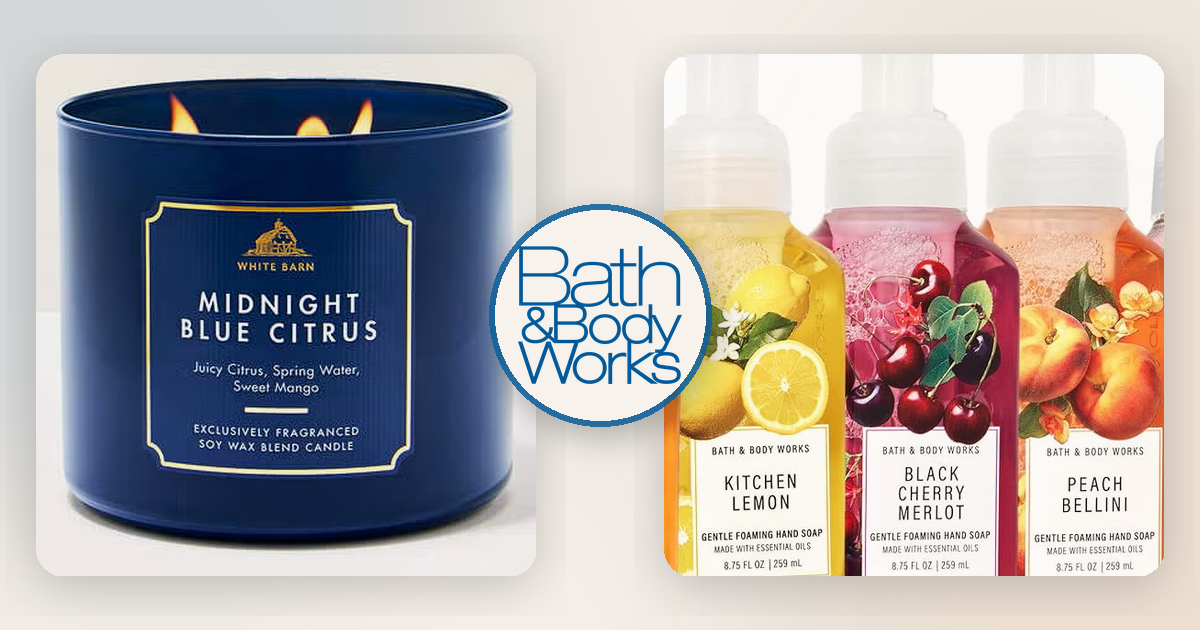
Bath & Body Works (BBWI) looks more compelling than its reputation suggests. At recent prices, the stock trades at under 6x earnings and about 0.5x sales, valuations that usually belong to a broken retailer, not a company that still produced $7.291 billion of revenue, $1.156 billion of adjusted operating income, and $865 million of free cash flow in fiscal 2025 while keeping a MagicDiligence ✅ Pass rating and positive six-month relative strength versus the market.
Few businesses look less serious than one built on candles, body spray, and hand soap. That surface impression is part of the opportunity. Bath & Body Works is easy to dismiss as a promotional mall chain, but the better description is a repeat-purchase fragrance and personal-care franchise that has spent more than 35 years turning small indulgences into habit.
Why The Business Is Better Than It Looks
The products are low ticket, but the behavior is durable. Customers do not buy a 3-wick candle or body cream the way they buy a couch or television. They buy them as refills, gifts, seasonal treats, or routine pantry items. That makes the business less glamorous than luxury beauty, but often more resilient than investors assume.
Bath & Body Works also has more scale than the stale mall-retailer label suggests. At fiscal year-end 2025, the company operated 1,927 stores in the U.S. and Canada, while partners operated 573 international stores and 34 international e-commerce sites in more than 45 countries. It also had 40 million active loyalty members and launched on Amazon in the U.S. in early 2026.
About 60% of the North American fleet was off-mall as of January 31, 2026, with management targeting 75% over time, and the company still benefits from a fast, mostly domestic, vertically integrated supply chain that helps it react to seasonal demand faster than a slower, more fragmented retailer.
The market often talks about Bath & Body Works as though it were just another troubled specialty retailer. The filings read more like a branded consumables business with a retail wrapper around it. Customers come back for familiar scents, promotions, gifting occasions, and affordable replenishment purchases. That repeat behavior is what gives the franchise its staying power.
Why The Valuation Looks Too Low
The easiest way to frame the bull case is to start with the multiple. A stock at under 6 P/E and roughly 0.5 P/S is being valued like a company with collapsing economics. Bath & Body Works does not look like that.
Fiscal 2025 net sales were down only 0.2% year over year. Adjusted operating income was still $1.156 billion. Operating cash flow was $1.102 billion. Free cash flow was $865 million. Those are not perfect numbers, but they are far too substantial to line up neatly with distressed valuation multiples.
The revenue mix also supports the idea that this is a real operating machine rather than a one-channel story. In 2025, U.S. and Canada stores generated $5.582 billion of sales, direct channel sales added $1.395 billion, and international sales and royalties contributed $314 million. Investors are not looking at a shrinking niche business. They are looking at a scaled franchise whose profits have come under pressure at the same time sentiment has turned deeply skeptical.
Even the 2026 outlook, which is cautious, still highlights the disconnect. Management reaffirmed guidance for full-year sales to decline 4.5% to 2.5%, adjusted EPS of $2.40 to $2.65, and about $600 million of free cash flow. That is a pressured year, but it is not a company in economic free fall. A stock that cheap does not need great news. It only needs the business to remain solidly profitable and cash generative.
That is what makes the valuation especially interesting. If the market is already pricing BBWI as though the core economics are headed for permanent impairment, then merely proving that the franchise is durable can be enough to close part of the gap.
Why BBWI Still Passes MagicDiligence
Bath & Body Works does not look like a battleground stock. There is no obvious fraud narrative, no active short-seller campaign defining the name, and no sign that management has to explain away the existence of the business each quarter. Its legal matters appear to be ordinary-course issues rather than something existential.
The balance sheet is leveraged, but the maturity schedule is less threatening than the headline debt number suggests. At fiscal year-end 2025, the company had $953 million of cash and $3.892 billion of total debt. After the first quarter of 2026, total debt had fallen to $3.613 billion following the redemption of the remaining 2027 notes, and current debt dropped to zero. The next notable maturity is the $444 million 2028 notes due in February 2028, followed by about $482 million due in 2029. It still had $820 million of cash, no borrowings on its ABL facility, and $544 million of ABL availability, with that facility not expiring until May 2030. Credit ratings were Ba2 at Moody's and BB+ at S&P, both with stable outlooks.
That is not pristine, but it does mean there is no large principal wall in the next year or so. The cyclicality risk is also real but often overstated. Bath & Body Works is consumer discretionary, but this is not a steel mill or shipping company at peak margins. The company is already operating through cautious consumers, tariff pressure, and a brand reset, which makes the current earnings base easier to trust than if the screen were being driven by obviously inflated results.
The first quarter of 2026 is a good example. Reported EPS was $0.90, but that included an $88 million interchange-litigation settlement and a $62 million tax benefit. On an adjusted basis, EPS was $0.32 and adjusted operating income was $151 million. The underlying business was weaker than the headline, but still clearly profitable. More importantly, the one-time items were transparent and disclosed, not hidden.
What The Market May Still Be Missing
The market usually underestimates businesses built on low-ticket repetition because the products seem too trivial to create durable economics. But fragrance, soap, and body care are categories where customers reliably come back. They rotate scents seasonally, stock up during promotions, buy around holidays, and treat the products as affordable indulgences even when they pull back elsewhere.
That behavior is what gives Bath & Body Works more resilience than the current multiple implies. Management's Consumer First Formula is also an attempt to sharpen that core franchise rather than reinvent it. The plan centers on better product innovation, stronger brand storytelling, wider reach through digital and third-party channels, and faster execution. The company is targeting $250 million of cost savings over two years, including $175 million in 2026, to help fund those investments.
Positive relative strength versus the market adds one more layer. Cheap stocks get more interesting when the fundamentals are still intact and the market starts to believe the story is not broken.
Why It Still Looks Buyable
The risks are easy to name: tariffs, soft traffic, promotional retail, and a still-meaningful debt load. The transformation could also take longer than management hopes.
But those are ordinary reasons for a stock to remain cheap. They are not the same as evidence that the business is structurally impaired.
Bath & Body Works does not need a heroic turnaround to work from here. It needs to keep generating cash, protect its fragrance franchise, execute competently on the Consumer First Formula, and avoid turning leverage into a refinancing problem. If it does that, a stock trading at under 6x earnings and about 0.5x sales can still look too cheap relative to the revenues and cash flows already in place.
| Current BBWI read | Value |
|---|---|
| MagicDiligence verdict | ✅ Pass |
| Momentum read | Positive 6M vs SPY |
| Valuation setup | Under 6x earnings and about 0.5x sales |
| Main bull point | Durable fragrance franchise with meaningful ongoing free cash flow |
| Main risk | Tariffs, soft traffic, and transformation execution |
Bath & Body Works looks cheap because the market is still arguing with the story.
That is often when Magic Formula names are most worth studying.
If you want to compare BBWI with the rest of the current shortlist, go back to the current MagicDiligence screen results.